Because regulation is essential to practice of religion

Because regulation is essential to practice of religion
  • Author: Dandvat
  • Posted on: 2016-11-16 08:00:00
  • Tags: Shree Chakrdhar Swami, Panch Krishan Avatar, Mahanubahv Panch Avatar, Mahanubhav Panth Literature, Knowing Mahanubhav Pantha
  • Post ID: 1479263400

🙏 दंडवत प्रणाम
नमो पंच कृष्ण अवतार


📰 Blogs

नमो पंच कृष्ण अवतार - Read the blogs of Mahanubhava Pantha. Go to Blogs

Yoga of wisdom and realization: Bhagvad Gita, Chapter VII, Verses 8-12

Yoga of wisdom and realization: B...

🙏 Dandvat Pranam 🙏

Yoga of wisdom and realization.

Prabhu Sri Krishna Ji said:
I am the sapidity in water, O Arjuna!
I am the light in the moon and the sun
I am the syllable AUM in all the Vedas, sound in ether, and virility in men
I am the sweet fragrance in earth and the brilliance in fire, the life in all beings
I am austerity in ascetics
Know Me, O Arjuna!
As the eternal seed of all beings
I am the intelligence of the intelligent
the splendour of the splendid objects am I!
Of the strong, I am the strength devoid of desire and attachment, and in [all] beings.
I am the desire unopposed to Dharma, O Arjuna!
Whatever being [and objects] that are pure, active and inert, know that they proceed from Me.
They are in Me, yet I am not in them.
Source: Bhagavad Gita, Chapter VII, Verses 8-12.

🙏 जय श्री कृष्ण जी 🙏
Read more
Theory of Swami Shree Chakardhara for Karmas and Liberation

Theory of Swami Shree Chakardhara...

🙏 Dandvat Pranam 🙏

Swami Shree Chakardhara depicted a theory about Karma, whatever we perform daily is a Karma. Jeevs are naturally a doer, Jeevs can’t even rest a while without doing a deed. Jeevs are very helpless by his nature and too much strong if he remembers who is his Parmeshwara.

Swami Ji’s theory is well explained and clear about the Karma. According to Swami Ji, Karmas are not always physically performed. Sometimes karmas are our thoughts and words also. Jeevs are doing karmas every second, even in any form like talking, walking, sleeping, eating, thinking and all the basic activites.

Origin of Karmas It has already been explained that in the first three creations, the jeevs prepared for the performance of deeds and in the fourth creation the deeds performed became rewardable. Now, in this the role of Devtas began. Devtas are ordered to give rewards to the jeevs. Since jeev can't reward himself so Devtas as an examiner takes charge to reward the Jeevs, but on the top, the Parmeshwara is holding the charge of Principal. Only by his grant, the Devtas give rewards to Jeevs, positive or negative both by deeds.

Three stages of Karmas Swami Ji explained the cause of Karmas and now he is explaining the three stage of Karmas. A single karma is performed by a process. These stage of Karmas are:
1️⃣ Thinking: This is the very first process, whatever jeevs want to perform, he thinks for that.
2️⃣ Speaking: After thinking and assuming, Jeevs secondly speak for that.
3️⃣ Acting: Very last, after speaking jeevs act for that physically.

Since all the karmas are performed by jeevs, but there is a hidden force working inside. The hidden force have coated a layer of dust on the jeevs. Actually, the karmas are the bondages and the real hurdle in the path of liberation. Jeevs can’t attain bliss without leaving the greed of karma.

🙏 जय श्री चक्रधर जी 🙏

🙏 जय श्री कृष्ण जी 🙏
Read more
Lord Shree Krishna choosen Arjuna only why not anyone else?

Lord Shree Krishna choosen Arjuna...

🙏 Dandvat Pranam 🙏

Krishna give knowledge of the Srimad Bhagavad-Gita to Arjuna because there were many reasons.

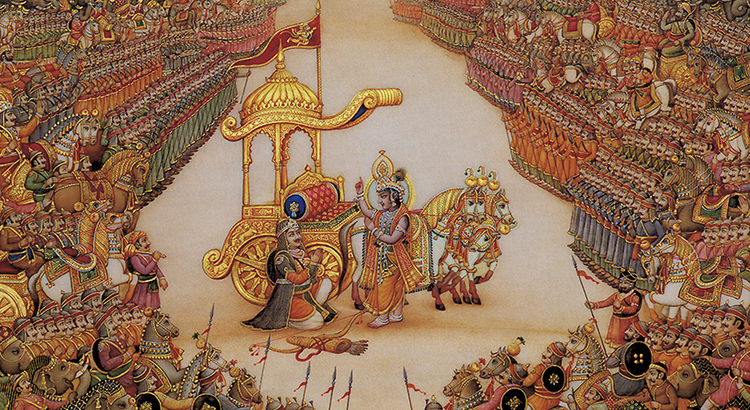
Context of the Kurukshetra War: The Gita is set on the battlefield of Kurukshetra, where Arjuna, a warrior prince, is filled with doubt and moral confusion about fighting in the war against his own relatives and teachers. Krishna's guidance is aimed at helping him navigate this crisis.

Preparedness to Learn: Arjuna's willingness to seek guidance and his openness to Krishna's teachings demonstrate his readiness to receive such profound knowledge. He acknowledges his confusion and seeks help, which is a prerequisite for spiritual learning.

Arjuna's Role: As a key figure in the Mahabharata, Arjuna embodies the struggles of duty (dharma) and righteousness. His internal conflict serves as a universal metaphor for the dilemmas faced by individuals in life.

🙏 जय श्री कृष्ण जी 🙏
Read more
Piercing fish eye

Piercing fish eye

🙏 Dandvat Pranam 🙏

A night before the day of Matsya Vedh (Piercing fish eye) competition, Krishna and Arjuna conversation.

Krishna: Arjuna, take care, put your step forward and concentrate on the eye of fish.
Arjuna: If i have to do everything , then what will you do?
Krishna: What you can't do, I will do.
Arjuna: And what is it that I can't do?
Krishna answers: I will keep the water steady.

No matter how much work we do for our goals, we are not the creator here. We are the co-creator of our life. We must perform our karma and trust that everything beyond our control will be taken care by God or The Universe or the Higher Power or any other name you believe in.

Remember God is your silent invisible partner.

🙏 जय श्री कृष्ण जी 🙏
Read more
Sarvadnya Shri Chakradhar Swami - The Divine Light

Sarvadnya Shri Chakradhar Swami -...

🙏 Dandvat Pranam 🙏

Sarvadnya Shri Chakradhar Swami, born in Gujarat, Karmabhumi in Maharashtra, the divine light of Sri Chakradhar Swami sustained Sanatan Dharma at a difficult time in Indian history by spiritual galvanization & healing of the Indic society at large. Temples in his honour existed even in Afghanistan at one time.

There are three paths which lead directly to establishing a relationship with God. According to the authority of Shree Mad Bhagavad Gita these paths have been designated as
Sarvadnya Shri Chakradhar Swami told his disciples that the lord takes avatars in all four yugas. Same was said by Shree Krishna Prabhu in Shree Mad Bhagavad Gita: “Dharma Sansthaapnaarthay Sambhavaami Yuge Yuge”

Accordingly, there is not a time in this world when an avatar is absent. But he told of only five of the innumerable avatars, namely: Shri Krishna, Shri Dattatreya Prabhu, Shri Chakrapani Prabhu, Shri Govindaprabhu, and Sarvadnya Shri Chakrdhar Swami (himself). Even knowing of one avatar, and walking on the path lightened by him, can lead to the ultimate bliss (moksha). There were only five, because these avatars fell in the Guru Parampara. Govindaprabhu was the guru of Shri Chakradhar Swami. Shri Chakrapani Prabhu was the guru of Shri Govindaprabhu. Shri Dattatreya Prabhu was the guru of Shri Chakrapani Prabhu. Shri Dattatreya Prabhu and Shri Krishna are not said to have another avatar as Guru.”

About Shree Chakradhar Swami
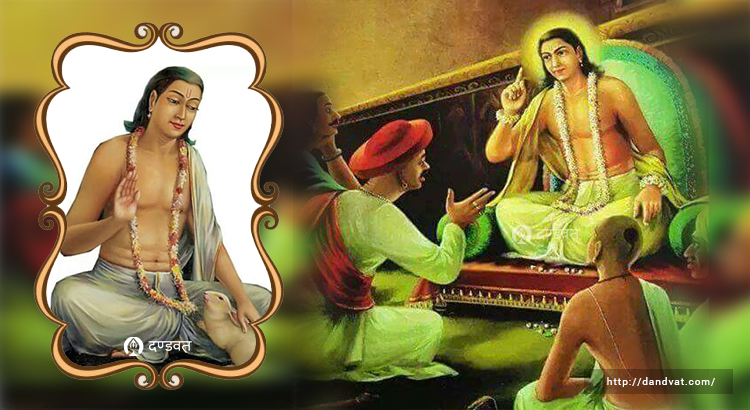
Haripaldeva was born at Bharavas (Bharuch,present day Gujarat) as the son of a king named Vishaldeva & his queen Mhalani devi. Haripaldeva died due to fever at the age of twenty at which point, a widely believed reincarnation of lord krishna named Shri Chakrapani Prabhu from Phaltan entered the dead body of Haripaldeva after which he revived. The thus reborn Haripaldeva was a greatly changed personality who would become known as Shree Chakradhar Swami.

Contribution of the Mahanubhav Panth to Marathi Literature
Sri Chakradhar Swami’s biography “Leela Charitra” written by his disciple Mahimbhatta is one of the first known works in Marathi literature; Also, Mahdaaisa, one of pant’s earlier devotees is considered to be the first Marathi poetess. One of the most important aspects of the philosophy propounded by him is asceticism. His fourfold teachings are: Non Violence, Celibacy, Asceticism and Bhakti.

Literature
Leela Charitra: Leela Charitra is thought to be the first biography written in the Marathi language. Mahimbhat’s second important literacy creation was Shri Govindaprabhucharitra or Rudhipurcharitra, a biography of Swami’s guru, Shri Govind Prabhu, in the form of 325 deeds. This was probably written in 1288, soon after the death of Shri Prabhu.
Satigranth: It was Nagadeva who systematized Mahanubhava. Mahadamba was a leading poetess of the movement. Besides Leelacharitra, Keshobas alias Keshavrajsuri has collected the Swami aphoristic vachans or actually spoken words, known as Sutrapath which is always on the lips of the follower of Mahanubhav.
Keshavrajsuri translated the some of “deeds” from Leelacharitra into Sanskrit in his work called “Ratnamala”. Similarly he has written in Sanskrit Dristantstotarm based on Dristantpath. The first Acharya of Mahanubhava Sect is Nagdevachrya or Bhatobas. His biography was written by Narendra and Bhaidevbas in about 1308.

There are seven works which have been written are known as satigranth and they are accepted by the followers of the sect. These are:
  1. Narendra : Rukaminiswayamvara (1292)
  2. Bhaskarbhat Borikar : Shishupalvadha (1312)
  3. Bhaskarbhat Borikar : Uddhavgita (1313)
  4. Damodar Pandit : Vachhaharana (1316)
  5. Ravalobas : Sahayadrivaranana (1353)
  6. Narayanbas Bahahaliye : Riddhipurvarnana (1418)
  7. Vishvanath Balapurkar : Janaprabodh (1418)

🙏 जय श्री कृष्ण जी 🙏

Read more
What is Karma: Action or Deed

What is Karma: Action or Deed

🙏 Dandvat Pranam 🙏

Karma is a Sanskrit term. It means action or deed. Any physical or mental action is Karma. Thinking is mental Karma. Karma is the sum total of our acts, both in the present life and in the preceding births.

Karma means not only action, but also the result of an action. There is a hidden power in Karma or action termed 'Adrishta' which brings in fruits of Karmas for the individual. The consequence of an action is really not a separate thing. It is a part of the action and cannot be divided from it.

According to the Gita, any action done with Nishkamya Bhava (selflessness) is Karma.
Lord Krishna says: Work incessantly. Your duty is to work but not to expect the fruits thereof. The central teaching of the Gita is non-attachment to work. Breathing, eating, seeing, hearing, thinking, etc., are all Karmas. Thinking is real Karma. Raga-dvesha (likes and dislikes) constitute real karma.

🙏 जय श्री कृष्ण जी 🙏
Read more