




Sudarshan Chakra: The wheel of time

Sudarshan Chakra: The wheel of time
  • Author: Dandvat
  • Posted on: 2017-10-16 08:00:00
  • Tags: Shree Krishna Prabhu, Knowing Mahanubhav Pantha, Bhagavad Gita, Krishan Leela
  • Post ID: 1508121000

🙏 दंडवत प्रणाम
नमो पंच कृष्ण अवतार


📰 Blogs

नमो पंच कृष्ण अवतार - Read the blogs of Mahanubhava Pantha. Go to Blogs

God With Form or God Without Form: Bhagvad Gita, Chapter XII, Verses 1-5

God With Form or God Without Form...

🙏 Dandvat Pranam 🙏

Like all of us, Arjuna was also confused about the proper way to worship God.

So, Arjuna very specifically asked bhagwan Krishna whether one should worship God as a person (WITH FORM) or worship God as impersonal (WITHOUT FORM).
(BG:12:1).

Prabhu Shree Krishna answered
Those who worship me with great faith, I consider them to be perfect. However, those worship the impersonal, formless, imperishable Brahman with proper control of senses also will finally attain me.
(Bhagavad Gita Chapter 12:2,3,4)

Bhagwan Krishna answered: Remember those whose minds are attached to the impersonal, formless, imperishable Brahman will find very difficult to progress in their path since they are born with body and mind.
(Bhagavad Gita Chapter 12:5)

Since the concept of God is very difficult to explain, Rishi Veda Vyasa wrote, we can worship God.
With form - SAGUNA BRAHMAN - as well as Without form - NIRGUNA BRAHMAN
Source: Bhagavad Gita, Chapter XII, Verses 1-5.

🙏 जय श्री कृष्ण जी 🙏
Read more
Piercing fish eye

Piercing fish eye

🙏 Dandvat Pranam 🙏

A night before the day of Matsya Vedh (Piercing fish eye) competition, Krishna and Arjuna conversation.

Krishna: Arjuna, take care, put your step forward and concentrate on the eye of fish.
Arjuna: If i have to do everything , then what will you do?
Krishna: What you can't do, I will do.
Arjuna: And what is it that I can't do?
Krishna answers: I will keep the water steady.

No matter how much work we do for our goals, we are not the creator here. We are the co-creator of our life. We must perform our karma and trust that everything beyond our control will be taken care by God or The Universe or the Higher Power or any other name you believe in.

Remember God is your silent invisible partner.

🙏 जय श्री कृष्ण जी 🙏
Read more
What is Karma: Action or Deed

What is Karma: Action or Deed

🙏 Dandvat Pranam 🙏

Karma is a Sanskrit term. It means action or deed. Any physical or mental action is Karma. Thinking is mental Karma. Karma is the sum total of our acts, both in the present life and in the preceding births.

Karma means not only action, but also the result of an action. There is a hidden power in Karma or action termed 'Adrishta' which brings in fruits of Karmas for the individual. The consequence of an action is really not a separate thing. It is a part of the action and cannot be divided from it.

According to the Gita, any action done with Nishkamya Bhava (selflessness) is Karma.
Lord Krishna says: Work incessantly. Your duty is to work but not to expect the fruits thereof. The central teaching of the Gita is non-attachment to work. Breathing, eating, seeing, hearing, thinking, etc., are all Karmas. Thinking is real Karma. Raga-dvesha (likes and dislikes) constitute real karma.

🙏 जय श्री कृष्ण जी 🙏
Read more
Brahmvidya Shastra and Nav Prakaran to learn the four elements Ishwar, Devta, Jeev & Prapanch

Brahmvidya Shastra and Nav Prakar...

🙏 Dandvat Pranam 🙏

Brahmvidya Shastra, It is a collection of main vachans (sutras) of Swami Shree Chakardhara and presents the philosophical core of Mahanubhav Pantha. Very well planned and carefully organized into various sections, it is revered as our Shastra mop Parmeshwar (God in the form of scripture).

Compiled with great care and understanding (in 1290) by the knowledgeable Keshav Vyas Suri from amongst 1500 episodes in the sacred source book Leela Charitra, is the second sacred book Brahmvidya Shastra.

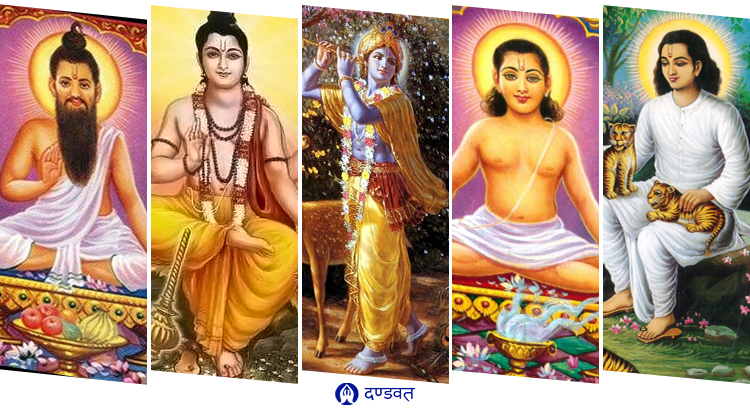
The Brahmvidya Shastra gives minute details of four elements (Char Paddarths- Ishwar, Devta, Jeev & Prapanch), Gods and the varied knowledge, way and source of attaining them. Nav Prakaran means nine chapters. Excluding the background chapter of Poorvi (along with Panch Krishna and Panch Naam).

Nav Prakaran:
🚩 Anya Vyavriti – अन्य व्यावृति (देवता पदार्थ)
🚩 Yug Dharma – युगधर्म
🚩 Vidya Marg – विद्या मार्ग
🚩 Sanhaar – संहार (प्रलय)
🚩 Sansaran – संसरण (रचना)
🚩 Udharan – उद्धरण
🚩 Mahavakya – महावाक्य
🚩 Nirvachan – निर्वचन
🚩 Astipari – असतिपरि

Other parts of Brahmvidya are Vichar Prakaran and Achar Prakaran. There are 285 sutras under Vichar Prakaran and 289 sutras under Achar Prakaran. Keshav Vyas Suri also selected from Leela Charitra 114 drishtants (illustrations) which were narrated by Swami to elaborate some deep philosophical thought. If this is included, Nav Prakaran becomes Dasham Prakaran.

🙏 जय श्री कृष्ण जी 🙏
Read more
Theory of Swami Shree Chakardhara for Karmas and Liberation

Theory of Swami Shree Chakardhara...

🙏 Dandvat Pranam 🙏

Swami Shree Chakardhara depicted a theory about Karma, whatever we perform daily is a Karma. Jeevs are naturally a doer, Jeevs can’t even rest a while without doing a deed. Jeevs are very helpless by his nature and too much strong if he remembers who is his Parmeshwara.

Swami Ji’s theory is well explained and clear about the Karma. According to Swami Ji, Karmas are not always physically performed. Sometimes karmas are our thoughts and words also. Jeevs are doing karmas every second, even in any form like talking, walking, sleeping, eating, thinking and all the basic activites.

Origin of Karmas It has already been explained that in the first three creations, the jeevs prepared for the performance of deeds and in the fourth creation the deeds performed became rewardable. Now, in this the role of Devtas began. Devtas are ordered to give rewards to the jeevs. Since jeev can't reward himself so Devtas as an examiner takes charge to reward the Jeevs, but on the top, the Parmeshwara is holding the charge of Principal. Only by his grant, the Devtas give rewards to Jeevs, positive or negative both by deeds.

Three stages of Karmas Swami Ji explained the cause of Karmas and now he is explaining the three stage of Karmas. A single karma is performed by a process. These stage of Karmas are:
1️⃣ Thinking: This is the very first process, whatever jeevs want to perform, he thinks for that.
2️⃣ Speaking: After thinking and assuming, Jeevs secondly speak for that.
3️⃣ Acting: Very last, after speaking jeevs act for that physically.

Since all the karmas are performed by jeevs, but there is a hidden force working inside. The hidden force have coated a layer of dust on the jeevs. Actually, the karmas are the bondages and the real hurdle in the path of liberation. Jeevs can’t attain bliss without leaving the greed of karma.

🙏 जय श्री चक्रधर जी 🙏

🙏 जय श्री कृष्ण जी 🙏
Read more
Three gates leading to the hell of self destruction: Bhagavad Gita, Chapter XVI, Verses 21

Three gates leading to the hell o...

🙏 Dandvat Pranam 🙏

|| त्रिविधं नरकस्येदं द्वारं नाशनमात्मन: ||
|| काम: क्रोधस्तथा लोभस्तस्मादेतत्त्रयं त्यजेत् ||
|| tri-vidhaṁ narakasyedaṁ dvāraṁ nāśhanam ātmanaḥ ||
|| kāmaḥ krodhas tathā lobhas tasmād etat trayaṁ tyajet ||

There are three gates leading to the hell of self-destruction for the soul - lust, anger, and greed.

Therefore, all should abandon these three:
  • Lust (Kama): Beyond just physical desire, this represents an obsessive craving for sensory gratification. It creates a cycle of never enough, leading to frustration when the high inevitably fades.
  • Anger (Krodha): Often the byproduct of frustrated desire. When we don't get what we want, anger flares up, destroying our ability to think rationally and damaging our relationships.
  • Greed (Lobha): The bottomless pit. It convinces us that our worth is tied to what we possess, ensuring we remain eternally dissatisfied regardless of our success.
Source: Bhagavad Gita, Chapter XVI, Verses 21.

🙏 जय श्री कृष्ण जी 🙏
Read more