




Daily rituals of Prabhu Shree Dattatreya

Daily rituals of Prabhu Shree Dattatreya
  • Author: Dandvat
  • Posted on: 2016-02-28 08:00:00
  • Tags: Shree Dattatreya Prabhu, Knowing Mahanubhav Pantha, Mahanubhav Panth Literature, Rituals of Mahanubhav Pantha
  • Post ID: 1456626600

🙏 दंडवत प्रणाम
नमो पंच कृष्ण अवतार


📰 Blogs

नमो पंच कृष्ण अवतार - Read the blogs of Mahanubhava Pantha. Go to Blogs

Bhagwan Shree Krishna and the universe in his mouth

Bhagwan Shree Krishna and the uni...

🙏 Dandvat Pranam 🙏

One day, while playing in the fields, little Krishna secretly ate mud. His friends went and told Yashoda about this. When Krishna returned home, Maa Yashoda caught Krishna by his ears and scolded him for putting dirt in his mouth. Krishna promptly replied that he had had a fight with his friends in the morning and to take revenge they were all lying and that Yashoda shouldn't believe them. He said that she was being unfair as she believed them instead of believing her son.

Yashoda ordered, If you have not taken any mud, then open your mouth. I shall see for myself.

Krishna obediently opened his mouth. But when Yashoda peered into his mouth, she was wonderstruck. She saw the entire universe: the mountains the oceans, the planets, air, fire, moon and the stars in his small mouth. Yashoda was stunned and began to wonder whether she were dreaming or actually seeing something extraordinary. She fell on the ground, unconscious.

When she recovered, she realised what had happened. The Lord Almighty, in all his glory, was before her very eyes. It was little Krishna, the incarnation of Vishnu. Yashoda took the little boy on her lap and hugged him and cried with joy.

🙏 जय श्री कृष्ण जी 🙏
Read more
Brahmvidya Shastra and Nav Prakaran to learn the four elements Ishwar, Devta, Jeev & Prapanch

Brahmvidya Shastra and Nav Prakar...

🙏 Dandvat Pranam 🙏

Brahmvidya Shastra, It is a collection of main vachans (sutras) of Swami Shree Chakardhara and presents the philosophical core of Mahanubhav Pantha. Very well planned and carefully organized into various sections, it is revered as our Shastra mop Parmeshwar (God in the form of scripture).

Compiled with great care and understanding (in 1290) by the knowledgeable Keshav Vyas Suri from amongst 1500 episodes in the sacred source book Leela Charitra, is the second sacred book Brahmvidya Shastra.

The Brahmvidya Shastra gives minute details of four elements (Char Paddarths- Ishwar, Devta, Jeev & Prapanch), Gods and the varied knowledge, way and source of attaining them. Nav Prakaran means nine chapters. Excluding the background chapter of Poorvi (along with Panch Krishna and Panch Naam).

Nav Prakaran:
🚩 Anya Vyavriti – अन्य व्यावृति (देवता पदार्थ)
🚩 Yug Dharma – युगधर्म
🚩 Vidya Marg – विद्या मार्ग
🚩 Sanhaar – संहार (प्रलय)
🚩 Sansaran – संसरण (रचना)
🚩 Udharan – उद्धरण
🚩 Mahavakya – महावाक्य
🚩 Nirvachan – निर्वचन
🚩 Astipari – असतिपरि

Other parts of Brahmvidya are Vichar Prakaran and Achar Prakaran. There are 285 sutras under Vichar Prakaran and 289 sutras under Achar Prakaran. Keshav Vyas Suri also selected from Leela Charitra 114 drishtants (illustrations) which were narrated by Swami to elaborate some deep philosophical thought. If this is included, Nav Prakaran becomes Dasham Prakaran.

🙏 जय श्री कृष्ण जी 🙏
Read more
Yoga of wisdom and realization: Bhagvad Gita, Chapter VII, Verses 8-12

Yoga of wisdom and realization: B...

🙏 Dandvat Pranam 🙏

Yoga of wisdom and realization.

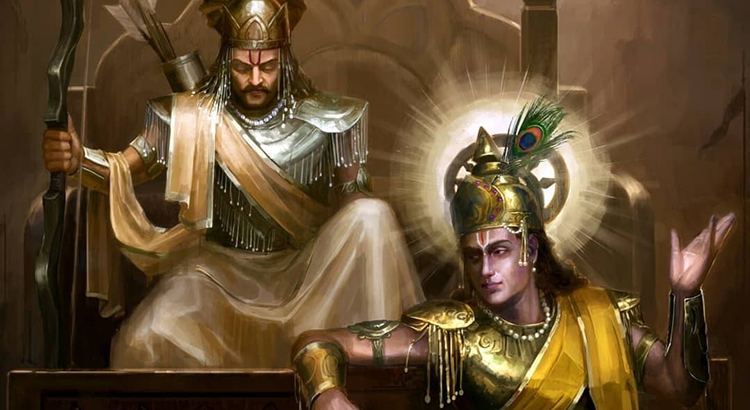
Prabhu Sri Krishna Ji said:
I am the sapidity in water, O Arjuna!
I am the light in the moon and the sun
I am the syllable AUM in all the Vedas, sound in ether, and virility in men
I am the sweet fragrance in earth and the brilliance in fire, the life in all beings
I am austerity in ascetics
Know Me, O Arjuna!
As the eternal seed of all beings
I am the intelligence of the intelligent
the splendour of the splendid objects am I!
Of the strong, I am the strength devoid of desire and attachment, and in [all] beings.
I am the desire unopposed to Dharma, O Arjuna!
Whatever being [and objects] that are pure, active and inert, know that they proceed from Me.
They are in Me, yet I am not in them.
Source: Bhagavad Gita, Chapter VII, Verses 8-12.

🙏 जय श्री कृष्ण जी 🙏
Read more
Shree Mad Bhagavad Gita one of the holy books of Hinduism and Mahanubhava

Shree Mad Bhagavad Gita one of th...

🙏 Dandvat Pranam 🙏

Shree Mad Bhagavad Gita one of the holy books of Hinduism. Shree Mad Bhagavad Gita is written thousands of years ago consists of 18 chapters. It is the samvad of Lord Shree Krishna and the Dhanusdhardi Arjuna. Shree Mad Bhagavad Gita is freely offering this presentation of Sri Mad Bhagavad Gita to the Earth as a gift to humanity. The date of the Kurukshetra war and the delivery of Bhagavad Gita to Arjuna by Sri Krishna are supposed to be around 3139 BCE.
There are three paths which lead directly to establishing a relationship with God. According to the authority of Shree Mad Bhagavad Gita these paths have been designated as
1. The yoga of perfect actions.
2. The yoga of perfect devotion.
3. The yoga of perfect knowledge.

Shree Mad Bhagavad Gita text is organized in twelve Skandhas (books) subdivided into 332 Adhyayas (chapters), and has between 16,000 to 18,000 verses, depending on the manuscript version. Of the 12 books, it is the 10th book with about 4,000 verses that has been the most popular, studied and recognized. The text asserts that it is Krishna in literary form.
Each chapter is called a yoga. Yoga is the science of the individual consciousness attaining communion with the Ultimate Consciousness. So each chapter is a highly specialized yoga revealing the path of attaining realization of the Ultimate Truth. The first six chapters have been classified as the Karma Yoga section as they mainly deal with the science of the individual consciousness attaining communion with the Ultimate Consciousness through actions.

These chapters are:
Attharah adhaya of Shree Mad Bhagavad Gita

1. Arjuna–Visada Yoga Prathama adhaya
Arjuna has requested Krishna to take his rath between the two armies, where he can see to who were in his opposition and who were with him . His growing dejection is described as he fears losing his friends and relatives as a consequence of Yudh.

2. Sankhya Yoga Dwitiya adhaya
After asking Shree Krishna for help, Shree Krishna teched him the Karma yoga, Gyaana yoga, Sankhya yoga, Buddhi yoga and the immortal nature of the soul Atma amar hai, ise koi nhi maar skta.. Sankhya Yog nam Dwitiya adhaya here refers to one of six orthodox schools of the Hindu Philosophy. This chapter is often considered the gyaan of the entire Shree Mad Bhagavad Gita.

3. Karma Yoga Tritiya adhaya
Shree Krishna explains how the Karma yoga – Performance of prescribed duties, but without attachment to results, is the appropriate course of action for Arjuna. Shree Krishna teached him how Karma will take him to the purification of soul.

4. Gyaana–Karma-Sanyasa Yoga Chaturth adhaya
Shree Krishna exposed that, he has lived through many births through prarambh of Universe. Always teaching yoga for the protection of the pious and the destruction of the impious and stresses the importance of accepting a guru. Shree Krishna teach him to remove the shanshya from his mind and approach to Karma.

5. Karma–Sanyasa Yoga Pancham adhaya
Arjuna asks Lord Shree Krishna if it is better to forgo action or to act. The Lord Shree Krishna answers that both are ways to the same goal but that acting in Karma yoga is superior. Arthat Prabhu shared Gyaan and Karam yoga both take him to Mokash, but Karam yoga is superior to Gyan yoga.

6. Atmasanyam Yoga Shasht adhaya
Krishna describes the Ashtanga yoga. Then, further throw light on the difficulties of the mind. How to gain the stable state of mind where nobody can influence you and the techniques by which mastery of the mind might be gained. Then your warrior will help you to understand the difference between Moah and Prem.

7. Gyaana Vigyaana Yoga Saptam adhaya
Vasudev Shree Krishna describes the absolute reality and its illusory energy Maya. Prabhu said this world is all his Maya, the illusion. People are tied to this world and Maya, they can’t see beyond this illusion. Those who can, for them there is no thing hidden.

8. Aksara Brahma Yoga Ashtam adhaya
This chapter contains eschatology of the Shree Mad Bhagavad Gita. Prabhu said, life is all about the 84 lacs births that a person take to reach this human body and the difference between death and life.

9. Raja Vidya Raja Guhya Yoga Navam adhaya
Lord Krishna explains Raja Vidya or Raja Guhya refers only to the Suddha bhakti yoga. Shree Bhagavan accepts that which is offered by the suddha bhaktas with love. In the last sloka in this chapter (man mana bhava mad-bhaktah), it is concluded that bhakti is the only means to attain Shri Bhagavan.

10. Vibhuti Vistara Yoga Dasham adhaya
Shree Krishna is described as the ultimate cause of all thee Jeev and Atma, Prabhu said without Paramatma, Atma and Jeev wouldn’t be single. Arjuna accepts Shree Krishna as the Supreme power.

11. Visvarupa Darsana Yoga Gyarawah adhaya
Arjuna requested Lord Shree Krishna to show him his Visvarupa, the Universal Avatar. Later Arjuna says, Prabhu your this avatar is of a being facing every way and emitting the radiance of a thousand suns, containing all other beings and material in existence. You are the Universe, there is nothing beyond you. You are the only GOD to worship.

12. Bhakti Yoga Barwah adhaya
Lord Shree Krishna reveals the path of devotion and worshio to God. Krishna describes the process of devotional service Bhakti yoga. He also explains different forms of spiritual disciplines and yoga process to attain the peace and learn the way to God.

13. Ksetra Ksetrajna Vibhaga Yoga Terwan adhaya
The difference between transient perishable physical body and the immutable eternal soul is described. Prabhu descirbed the difference between actual and the perceptual. Then LordShree Krishna tells about the nature of problem and its solution.

14. Gunatraya Vibhaga Yoga Choudwan adhaya
Prabhu SHree Krishna explains the three modes (Gunas) of material nature pertaining to goodness, passion, and nescience. The sankalpa of Prabhu is thus the instrumental cause of creation, and his Illusion Maya becomes the material cause. This Maya has three Gunas – the Sattva, Rajas & Tamo Gunas.

15. Purusottama Yoga Pandrwan adhaya
Lord Shree Krishna identifies the transcendental characteristics of God such as, Omnipotence, Omniscience, and Omnipresence. Lord Shree Krishna also describes a symbolic tree representing material existence. “Creation, with its Eternal as well as ephemeral aspects, can be likened to the Ashwattha tree which has its roots above and branches below. the Vedas are its leaves. He who fully comprehends the nature of this tree truly understands.”

16. Daivasura Sampad Vibhaga Yoga Solwan adhaya
Vasudev Shree Krishna identifies the human traits of the Divine (Sure) and the Evil (Asure) natures. He counsels that to attain the supreme destination one must give up lust, anger, greed, and discern between right and wrong action by discernment through Buddhi and evidence from the scriptures.

17. Sraddhatraya Vibhaga Yoga Satarwan adhaya
Lord Shree Krishna qualifies the three types of Faith, Thoughts, Deeds and even Eating habits corresponding to the three modes (gunas). These 3 type of Gunas are – the Sattva, Rajas & Tamo Gunas.

18. Moksha Sanyasa Yoga Attharwan adhaya
Here finally God the Vasudev Shree Krishna gives the conclusions of previous seventeen chapters. Then again, Prabhu asks Arjuna to abandon all forms of Dharma, fix your mind on me, be devoted to me, perform sacrifice and simply follow his gyan and be the part of Dharam Yudh. I promise, (since) you are dear to me.

🙏 जय श्री कृष्ण जी 🙏
Read more
Shree Datta is a Hindu deity considered to be an avatar of Hindu god Shree Krishna

Shree Datta is a Hindu deity cons...

🙏 Dandvat Pranam 🙏

Shree Dattatreya or Shree Datta is a Hindu deity considered to be an avatar of Hindu god Shree Krishna, known as Shree Dattatreya.
The name Dattatreya is composed of two words - “Datta” (meaning given) and “Atreya”, referring to the sage Atri, his physical father.
Various Hindu sects worship him differently, though Shree Dattatreya is considered a form of all the three deities. He is especially considered an avatar of Vishnu while his siblings the moon-god Chandra and the sage Durvasa are regarded as forms of Brahma and Shiva respectively. However, spiritual seekers pray to this Supreme Teacher for knowledge of the Absolute Truth. Hindu theology, credits Dattatreya as the author of the Tripura Rahasya given to Parashurama, a treatise on Advaita Vedanta. He is specially worshipped on his birthday, Datta Jayanti.

Shree Dattatreya traditions
  • Puranic tradition
  • Mahanubhav tradition
  • Shri Gurucharitra tradition
  • Sakalmat Sampradaya tradition
  • Avadhut Panth tradition
  • Shri Dattpith Sansthan Pathri

One who is in possession of all six of these opulences at the same time and who possesses them to an unlimited degree is understood to be the Supreme Personality of Godhead according to Parasara Muni a great Vedic authority.
Shree Dattatreya was born to the sage Atri, who had been promised by Parameshvara (the Almighty), that He, Parameshvara, would be incarnated as his son. Some Hindu sects familiar with the trinity also attribute Shree Dattatreya's incarnation as of all the three- Vishnu, Shiva and Brahma, indirectly meaning to be all powerful and above all. This is just one of the many legends related to the birth of Lord Dattatreya. Others suggest a more mystical origin of Shree Dattatreya. Some of the sources claim that he was born in Kashmir jungles near the sacred Amarnath.

Appearance Puranic tradition
मालाकमंडलुरधः करपद्मयुग्मे, मध्यस्थ पाणियुगुले डमरूत्रिशूले
यस्यस्त उर्ध्वकरयोः शुभशंखचक्रे वंदे तमत्रिवरदं भुजषटकयुक्तम
I bow to the one who has six hands and whose lowest two hands have maalaa and kamandalu, middle pair of hands hold damaru and trishool and top two hands have holy Shankh and Chakra) Other depictions, however, show other weapons like 'Gada' in the hands of Dattatreya sometimes.

Names of Shri Datta & their meanings:
🚩 Datta >> Datta is one who has been bestowed with the spiritual experience of the nirgun? (Nonmaterialised), meaning, the one who has been given the experience that the 'Self' is Brahman (God in His aspect as the Creator of the universe) or mukta (Liberated) self or the soul.
🚩 Avadhut >> One whose (spiritual) ignorance has been dispelled with spiritual knowledge, meaning, the one who emancipates all.
🚩 Dattatreya >> This word is derived from Datta and Atreya. The meaning of 'Datta' has already been explained above. 'Atreya' means the son of Sage Atri.
🚩 Digambar >> Is the principle which gives company to an embodied soul till it gets Final Liberation in the radiance of the sky, i.e. beyond all the directions.
🚩 Shripad >> 'Shri' is the never-ending principle of God. The principle that takes an embodied soul to that principle of God or to the Holy Feet of 'Shri' principle, is the Datta principle in Shripad.
🚩 Vallabh >> The Datta principle in the form of Vallabh protects the Universe from the circular-shaped negative energies that create fear psychosis, and thus protects the embodied souls.

🙏 जय श्री कृष्ण जी 🙏
Read more
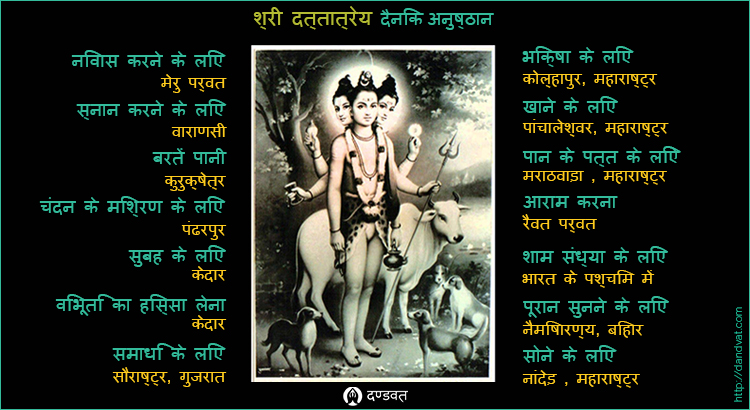
Daily rituals of Prabhu Shree Dattatreya

Daily rituals of Prabhu Shree Dat...

🙏 Dandvat Pranam 🙏

Shree Dattatreya - The Universal Guru. He had descended on this earth to establish three things and beliefs
1. Satya – The Universal Truth.
2. Rta – The Cosmic Order.
3. Dharma – The perennial principles.
Prabhu Shree Datta have numbers of leelas, we cant even count them. Here i'm trying to describe the daily life routine of Shree Datt parbhu in few lines. Hope all you will appreciate and share with the communities. From the start of day to end.
  • 1. Meru Mountain, Uttarakhand – Prabhu G used to reside at Meru mountain.
  • 2. Varanasi, Bihar – Prabhu G always take bathe on Ghats of Ganga, Varanasi, Bihar at early morning. Most listened leela of prabhu g is sanan at Ganga ghat. He always do check of his loving people at morning time on the walk to Varanasi.
  • 3. Kurukshetra, Haryana – Prabhu G used to Sipping water at the Kurukshetra
  • 4. Pandharpur – Shree Datta prabhu G always do the chandan tilak prakriya at Pandharpur.
  • 5. Kedar – Prabhu G always do devotional japp at Kedar also called morning sandhya.
  • 6. Kedar – Prabhu G partake Vibhuti/Bhasma (ash) at Kedar after the morning sandhya.
  • 7. Girnar, Saurashtra, Gujarat – Prabhu G always do meditation in Girnar, Saurashtra, Gujarat.
  • 8. Kolhapur, Maharashtra – One of most famous routine of Prabhu G is bhiksha in the Kolhapur, Maharashtra area after the noon.
  • 9. Panchaleshwar, Maharashtra – Agin one of most famous and listed leela of Prabhu Shree Datt is takin lunch after bhiksha on the banks of Godavari river.
  • 10. Marathwada, Maharashtra – After having luch, Prabhu G use to take roll of betel leaves in Rakshasbhuvan, District Beed, Marathwada, Maharashtra.
  • 11. Raivat Mountain, Gujarat, India – Prabhu G takes some rest and Raivat Mountain (Girnar).
  • 12. Western Ocean, Bharat – Prabhu Shree Dattatray g after having the rest always spend his time at the western part of Bharat. Generally at the ocean head.
  • 13. Naimisharanya, Bihar – Shree Datt prabhu G spend his most of time to hear discourses and kirtans at Naranarayan Ashram in Naimisharanya, Bihar.
  • 14. Mahurgad, Maharashtra – At the end of day Prabhu G takes the sleep at the Sahyaparvat in Nanded, Maharashtra.
All these prakriyas are taken from the part of leelas done by prabhu ji.

Teachings of Shree Dattatreya Maharaj
Prabhu Ji gave Ashtanga Yoga (eight fold path of Yoga) to the world thousands of years ago.
1. Yama – non-killing, truthfulness, non-stealing, continence, and non-receiving of any gifts. Moral discipline.
2. Niyama – cleanliness, contentment, austerity, study and self-surrender to God. Moral discipline Yama and Niyama are moral training and form the basis of Yoga. As these two become established, the Yogi will begin to realize the fruits of his practice.
3. Asana – posture.
4. Pranayama – ‘Prana’ is the life-force, ‘yama’ is control. ‘Pranayama’ consists of breath control exercises.
5. Pratyahara – withdrawal of senses from sense objects.
6. Dharana – concentration.
7. Dhyana – meditation.
8. Samadhi – the transcendental or super conscious state of being one with God: Principle.

🙏 जय श्री कृष्ण जी 🙏
Read more